
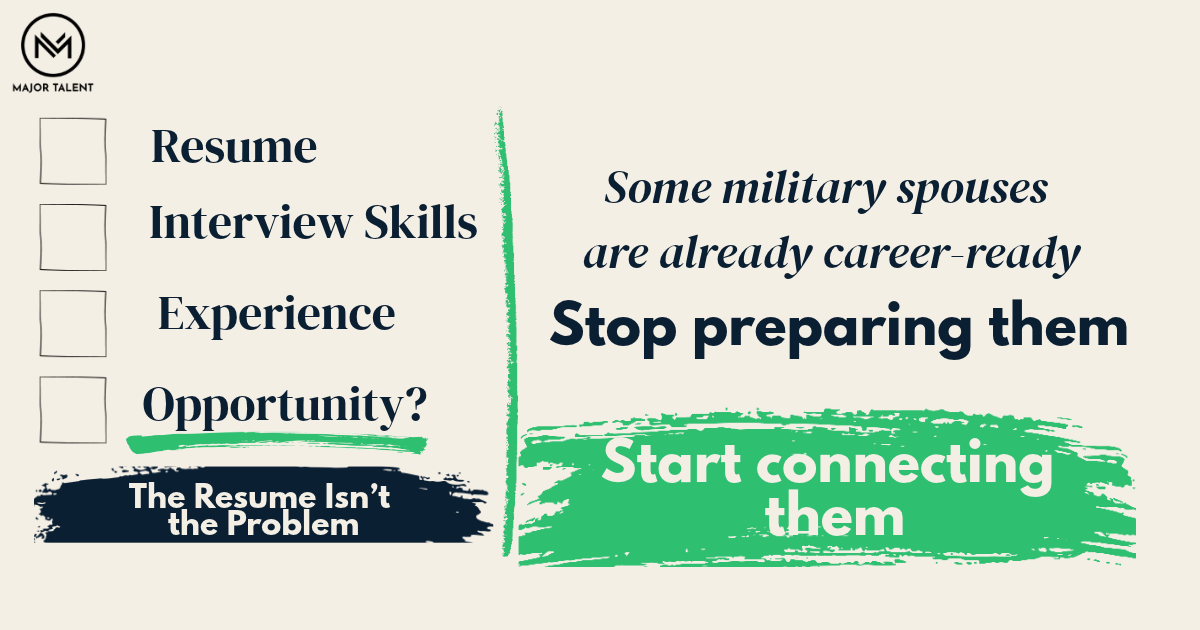
Why experienced military spouses may need opportunity more than another career workshop.
The last box has finally been unpacked. The kids are enrolled in school. You’ve found a new doctor and dentist. After a whirlwind summer that included a partial DITY move halfway across the country, you finally get a chance to breathe. But only for a moment, because now it’s time to figure out what comes next for your career.
And as a military spouse, there’s no shortage of resources offering advice on updating your LinkedIn profile, tailoring your resume to the job description, outsmarting applicant tracking systems, preparing for interviews, and, of course, networking, networking, networking!
The Department of War’s Military Spouse Employment Partnership (MSEP) program alone now includes more than 1,000 companies committed to hiring military spouses. Add each installation’s local programs, nonprofits, fellowships, targeted job boards, networking groups, and military spouse organizations all trying to tackle the issue, and you can easily become overwhelmed.
Over the past decade, as military spouse employment has increasingly become a retention issue for service members whose spouses are pursuing their own careers, the community has responded by creating an ever-growing number of programs and resources designed to help spouses find and keep meaningful employment through the rollercoaster that is military life. While I’m grateful for the ways organizations have come together to create so many options for military spouses, I feel one segment of the population is still missing from these resources: the spouse who has used them and is still unemployed.
There is a large number of spouses who have an advanced degree, know how to tailor their resumes, are rockstars when it comes to interviews, and have years of professional experience proving they’re skilled but are still unemployed. That’s the part of the issue that I feel the community has been missing.
After my family’s most recent PCS, I didn’t need someone to tell me how to tailor my resume or update my LinkedIn profile; I needed someone willing to hire me. After 10 years building a successful communications career across different industries, with a track record to prove it, I simply needed an opportunity.
And over the past few years, opportunities for spouses have become harder to find. During the pandemic, after so many employees proved they could complete their job without having to sit in traffic for an hour each way to do that same work in a cubicle, it seemed like organizations would be pivoting to offering more remote jobs, and for a while that was true. But more recently, there has been a push to return to the office full-time or shift formerly remote positions to hybrid roles.
That creates a problem for spouses that no platform, resume workshop, or interview prep class can solve. No amount of career preparation courses can overcome a lack of opportunity where the military decides to send you. But opportunity is only part of the problem. I could find plenty of jobs I’m more than qualified for, but that doesn’t mean I have a good chance of getting one. Anyone who is job searching knows the routine. You find a job you’d like to apply for, research the organization, spend a few hours tailoring your resume, write a cover letter designed to make you stand out (or in today’s world, ask AI to do a few of these steps for you), create a profile on whatever platform the organization’s using to manage their applications, upload your resume, then input all of that same information into their system manually, hit submit, and wait.
Sometimes you hear from them quickly and receive a message that sounds something like “While your resume and experience were impressive, we’ve decided to move forward with other candidates at this time,” or maybe you get an interview, or maybe, after all the hours you spent working through their system, you never hear from them again. But at least you got a new username and password out of the experience.
And then you move on to the next application.
While this job search ritual isn’t unique to military spouses, the number of opportunities available is much smaller because of how often we move, where we live, and whether the employer offers remote work. That smaller pool makes each application more important, and each rejection feels like the door closing on continuing our professional careers.
So, the problem spouses are facing isn’t where to upload the next resume or that their interview skills aren’t up to par, but the number of times they’re forced to keep on repeating this ritual because of the ever-nomadic military lifestyle, and often with fewer opportunities to choose from each time.
The frustrating part of this never-ending exercise is that while there are thousands of military spouses at any given time with the degrees, certifications, and/or professional experience that employers are searching for; there are often just as many employers looking for those credentials; the problem is that they can’t always find each other.
And that’s where I think there’s an opportunity for the military community to come together to try and fix the high unemployment and underemployment rates for this population. Instead of focusing on job-search preparation, more organizations need to find better ways to connect employers looking for those specific skills with spouses who already have them. Spouses shouldn’t have to continuously start that job search from scratch every time a new set of PCS orders come through.
Connecting the HR professional and spouse with 10 years of experience to an employer a few states away that is willing to hire remotely shouldn’t feel like trying to find a needle in a haystack, or as a sailor might say, finding a submarine in the Atlantic.
And that’s where I think that platforms like Major Talent can fill in that gap.
When I first heard about Major Talent, I was skeptical that their model would be any different than the many others I had tried on my quest for reemployment after a PCS. But what they have incorporated that is significantly different from all the other platforms I’ve tried is that the search works both ways.
While it’s possible for service members, veterans, and spouses to search for jobs that interest them, just as they would on so many other platforms, it’s also possible for an employer to find that HR professional themselves.
The burden of forging that connection that eventually results in a successful hire is no longer only on the job seeker; it’s a shared responsibility between the employer and the candidate. And after years of telling spouses, they need to network, network, network, it’s nice to see a platform that asks employers to be part of the solution, too.
So, after the boxes are unpacked and it’s time for spouses to figure out what comes next in their careers, maybe the first question shouldn’t always be, “What else do I need to do to land that job?”
Sometimes, we’ve already done the work; we only need the opportunity to prove it.